Arrival: Language, Time, and the Power of Understanding
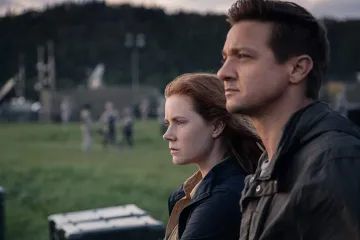
But now I’m not so sure I believe in beginnings and endings. There are days that define your story beyond your life. Like the day they arrived.
Science fiction is a genre that makes us think by asking questions about our advancement as a species. Some sci-fi movies eschew emotion to focus on the thoughts and ethics of their subject matter, like Ex Machina. Others dive head-first into emotion, making that the focus rather than the ideas, like Close Encounters of the Third Kind. Very few films do a good job of stimulating both the intellect and the emotions of the viewers. Arrival is a smart film that does exactly that. Directed by Denis Villeneuve (Blade Runner 2049, Sicario) and starring Amy Adams and Jeremy Renner, this film shows us a first contact between humans and aliens who have chosen to land here. This isn’t an action film—it’s a much more cerebral and thought-provoking experience, although it’s not hard to follow or boring. In fact, it’s rare that a film that makes you think like this is made for mainstream audiences, let alone made so well, earning it a spot on this list.
The story opens with 12 alien ships landing at various locations on earth. In order to investigate peacefully, the government finds two experts to help them: Louise Banks, a linguist, and Ian Donnelly, a scientist. It’s their job to understand the aliens, figure out how to communicate with them, and determine if they’re a threat. Through all of that, we see Louise’s memories of a lost child and a failed marriage that haunt her throughout the film and become more important as the film progresses. I’m not going to give away any more than that, but it’s a very solid plot.
Like their ship or their bodies, their written language has no forward or backward direction. Linguists call this ‘nonlinear orthography,’ which raises the question: Is this how they think?
Pretty much right from the start of the film, the question of why the aliens are there hangs over everyone and moves the plot forward, and the answer they eventually give is surprising and somewhat unique in this genre. This isn’t a simple story of making first contact, like Close Encounters of the Third Kind—the aliens have a solid and complex reason for being there, and all the mysterious encounters make sense in the end. The film went much deeper than I originally expected, and the ending strays from hard science a bit to also focus on language, psychology, and even our perception of space and time. This is a film that will appeal to language and psychology enthusiasts as much as those with pure scientific minds. A film covering that much ground has the potential to be a confusing train-wreck, but this was surprisingly easy to follow, although hard to predict. When I figured out what was going on, I was hooked for the rest of the film to see how it played out.
Director Denis Villeneuve took great strides to make this film realistic. He hired scientists to act as consultants to make sure the scientist characters in the film and the tools they used were all portrayed as it should. But, even more impressive, this feels like the real world. Many sci-fi films feel far removed from reality, either happening in some far-off future or happening to people you would never meet in real life. This one feels like it could happen tomorrow. Even though I don’t know a lot of scientists or linguists, both main characters feel very real and grounded, thanks to great performances from Adams and Renner. It’s this grounding in reality that makes the fantastic place it takes us even more powerful.
Though this is a cerebral and somewhat slow-moving film, it is not boring. Adams and Renner have enough charisma to keep audiences attached to their characters, and getting bits of Louise’s memories throughout the film give her character some depth. There’s plenty of tension, initially in just determining the nature of the aliens, but eventually happening on a larger scale as well. They mystery and the final reveal, while not on the same level as some of the great like The Usual Suspects, is still engrossing and interesting and recontextualizes many of the earlier scenes in a way that a good mystery should. If you’re expecting an action film, maybe you’ll be disappointed, but I certainly wasn’t bored watching this.
Should I Watch Arrival?
Arrival is an intelligent and well-written sci-fi film that gives us a healthy dose of drama and emotion without being overly sentimental or illogical, and it’s a fairly competent mystery too, with clues revealed throughout, although many of them only make sense in retrospect. There also aren’t many movies that focus on language and its effect on the brain (I used to work for an organization that did literacy work in developing countries, so this is very dear to me), and it actually makes that topic interesting. This is a science fiction film that accomplishes what few others do: it appeals to a general audience without sacrificing anything that makes science fiction great. For that reason, this is a film I’d recommend to anyone.
Movies Like Arrival
- Contact (1997) - Based on a book written by Carl Sagan, Contact shows that scientific discovery can evoke feelings of awe and wonder and ask for leaps of faith as much as any religious experience. It shares themes of communication and alien contact with Arrival, and similarly shows the emotional side of science as well as the intellectual.
- Interstellar (2014) - This is, at its core, an emotional story about scientific discovery and wonder, but it doesn’t sacrifice one for the other. There’s a sense of adventure that’s lacking in Arrival, but the film touches both the head and the heart in a similar way. Also, the visuals and music are outstanding and worth watching on a nice screen.
- Close Encounters of the Third Kind (1977) - This film focuses more on emotions than science, but it’s an optimistic take on alien contact with Spielberg’s signature emotional warmth and sentimentality. There’s a childlike wonder, although the film deals with some of the more difficult aspects of adults going all-in on awe and wonder, even when it doesn’t make sense.
Academy Awards
Winner: Best Sound Editing
Nominee: Best Picture, Best Director, Best Screenplay, Best Cinematography, Best Editing, Best Sound Mixing, Best Production Design
- Runtime: 1:56
- Director: Denis Villeneuve
- Year: 2016
- Genres: drama, mystery, sci-fi
- Rating: PG-13

About Brandon
My name is Brandon, and I love movies. Not bad ones, though—just the good ones. I’m curating and reviewing a list of classic, essential-viewing, or just plain good movies from all decades, and I've been reviewing them since 2016. I also co-host Peculiar Picture Show, a podcast about movies and mental health and write about Dungeons & Dragons options, builds, and optimization.
More in 2010s

The Perks of Being a Wallflower: Hipster Teens Discover Depression
2012
drama, LGBTQ, romance, teen
Her: You'll Believe a Man Can Love His Phone's Operating System
2013
drama, indie, romance, sci-fi
Ex Machina: A Sci-Fi Film That Passes the Turing Test
2014
mystery, sci-fi, thriller
More in drama
The Squid and the Whale: An Emotionally Brutal Divorce Story
2005
drama, indie
The Shawshank Redemption: A Tale of Perseverence and Hope
1994
drama
Marriage Story: A Masterful, Heartbreaking Portrait of Divorce
2019
comedy, drama, indie
More in mystery

Psycho: A Horror Classic That Holds Up Well Today
1960
horror, mystery

Hot Fuzz: A Rural British Buddy Cop Movie
2007
action, comedy, mystery, parody

Chinatown: A Neo-Noir Film With Modern Edge and Sensibility
1974
film noir, mystery
More in sci-fi
Blade Runner: Mortality and the Machine
1982
sci-fi
Her: You'll Believe a Man Can Love His Phone's Operating System
2013
drama, indie, romance, sci-fi
Back to the Future: Time Travel and Timeless Fun
1985
adventure, sci-fi