2001: A Space Odyssey: Kubrick’s Sci-Fi Masterpiece Reigns Supreme
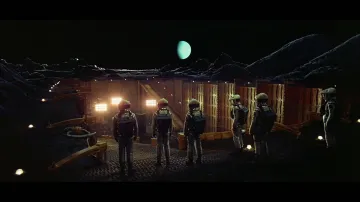
This mission is too important for me to allow you to jeopardize it.
2001: A Space Odyssey is a masterpiece of cinema. Directed by Stanley Kubrick (The Shining, A Clockwork Orange), this 1968 film is widely regarded as one of the most influential science fiction films of all time. That said, it helps to have appropriate expectations for this film. If you’re expecting a gripping plot or a coherent message, you’re going to have a bad time. 2001: A Space Odyssey is more like a trip to an abstract art museum than a trip to the movies: it’s beautiful and stimulating, but it’s ultimately up to you to imply meaning based on your personal interpretation. Kubrick himself has refused to offer any explanation for the baffling ending, and, although many have put forth theories, none have completely resolved all of the mysteries presented here.
The plot for 2001 is simple, but leaves a lot to be discovered. Humanity discovers a strange alien obelisk with the power to greatly accelerate evolution. That’s the first hour of the movie, which moves very slowly. The obelisk shot out a radio broadcast toward Jupiter, so humanity launches a mission to learn more about it. That’s where a pretty coherent and gripping plot takes shape and plays out for the next hour of the film. The last half hour of the film is perhaps the most confusing, culminating in an ending that at first seems like the ultimate non sequitur. Is it nonsense or is it brilliant? That’s up to you to decide. After viewing, I would urge you to read others’ interpretations of the film. I can’t say I fully understand it, but I have more appreciation for it after some research.
I can feel it. My mind is going. There is no question about it. I can feel it.
One thing 2001 does exceptionally well is art direction. It’s beautifully shot, and some of the artificial gravity scenes are impressive even today. Nearly 50 years later, film has evolved to the point that many of the shots and scenes in this film seem almost academic in nature, but at the time, this movie was stunning. The use of sparse classical music is effective, if not exciting, but the scenes of expertly used near silence were much more impactful. There were a few long scenes of astronauts in open space with only the sound of breathing, which really emphasized how alone these characters were.
The trip to Jupiter was the most engrossing part of the movie. The character of HAL, an artificial intelligence, is fascinating in its uncanny valley of emotions. I don’t want to give anything away, but the finale of that section of the movie was chilling and heartbreaking—definitely the best part of the movie.
Should I Watch 2001: A Space Odyssey?
2001: A Space Odyssey is an interesting movie. I’d be hesitant to recommend it to general audiences, despite its significance, due to its very slow pace and ambiguous ending. It’s a movie that requires a lot of thought to arrive at any modicum of satisfaction, and even then, there’s no definitive message to “get”—the question is not what it means, but what it means to you. It’s still one of the most iconic movies of all time, so it comes highly recommended to serious fans of the film medium and those wanting to understand its history; and it’s one of the most influential sci-fi films of all time, so sci-fi fans will appreciate its influence on the genre. If this sounds interesting to you, check it out!
Movies Like 2001: A Space Odyssey
- Solaris (1972) - The most direct spiritual companion to 2001, Solaris is a slow, emotional, and philosophical journey about memory, guilt, and the unknowable. It similarly focuses on questions of humanity and meaning, and it’s similarly abstract in its execution.
- Interstellar (2014) - Though more modern and less abstract, Interstellar deals with similar themes of exploration and pushing the limits of human potential. It seems like a movie with hard answers to all of its questions, but it leaves many of its complex questions unanswered, instead leaving us to think about them on our own. I hesitate to call anything a modern version of 2001, but this is in the same vein.
- Contact (1997) - The philosophy in this film is more grounded and accessible, although smaller in scope than 2001. The film, based on a book by Carl Sagan, decouples awe and wonder from religion, showing that acts of devotion and leaps of faith are important for anyone, regardless of their beliefs or religion. The film is much more personal than 2001, but also leads us to think about existence and human potential.
Academy Awards
Winner: Best Effects, Special Visual Effects (Stanley Kubrick)
Nominee: Best Director (Stanley Kubrick), Best Writing, Story and Screenplay – Written Directly for the Screen (Stanley Kubrick, Arthur C. Clarke), Best Art Direction-Set Decoration (Anthony Masters, Harry Lange, Ernest Archer)
- Runtime: 2:41
- Director: Stanley Kubrick
- Year: 1968
- Genres: sci-fi
- Rating: G

About Brandon
My name is Brandon, and I love movies. Not bad ones, though—just the good ones. I’m curating and reviewing a list of classic, essential-viewing, or just plain good movies from all decades, and I've been reviewing them since 2016. I also co-host Peculiar Picture Show, a podcast about movies and mental health and write about Dungeons & Dragons options, builds, and optimization.
More in Stanley Kubrick
Full Metal Jacket: Kubrick Gets Real About the Harsh Reality of War
1987
war

The Shining: A Deconstruction of Sanity
1980
horror
More in 1960s
Lawrence of Arabia: The Big, Epic War Film Everyone Should See
1962
biopic, epic, historical, war

Psycho: A Horror Classic That Holds Up Well Today
1960
horror, mystery
Midnight Cowboy: The Big City Destroys Big Dreams
1969
drama
More in sci-fi
Donnie Darko: A Mind-Bending Portrait of Mental Illness
2001
indie, sci-fi, teen
Jurassic Park: The Best Dinosaur Movie of All Time
1993
sci-fi, thriller
Metropolis: The Original Science-Fiction Film
1927
sci-fi