Battle Royale: The Brutal Precursor to The Hunger Games
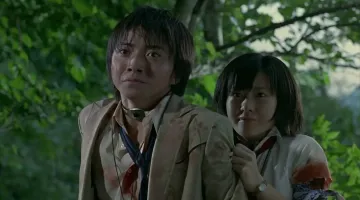
Listen, if you hate someone, you take the consequences.
12 years before The Hunger Games became a worldwide hit, the Japanese film Battle Royale did the same thing, but with a more assertive stance. Directed by Kinji Fukasaku (Fall Guy, Crest of Betrayal), who turned 70 years old during the production of the low-budget ultra-violent film, this was a story so controversial that the Japanese parliament tried (unsuccessfully) to get both the novel and the film banned, and Germany actually did get the film banned for quite some time. But this film is more than just senseless stylized gore—there’s some intelligent plotting and well-developed characters here, and a great point underneath it all. For one reason or another (it’s disputed why), this film didn’t see any sort of release in America until very recently when it hit Netflix, so this film became an underground cult classic among hipsters and film buffs lucky enough to get their hands on a copy. The film is far from perfect, but I really enjoyed the film and what it had to say.
The film is set in the near-future when economic disaster has hit Japan, causing the government to take a much tighter grip on its people. Youth indifference is at an all-time high and adults are sick of it, so they start the Battle Royale, where a random ninth-grade class is chosen each year to fight to the death. Student Shuya Nanahara immediately vows to protect his friend and potential girlfriend, Noriko Nakagawa. The other students react in very different ways with some playing into the violence that’s expected of them and others trying to fight the game and strive for peace, but much like a Vegas casino, the house always wins. Shuya and Noriko struggle to keep their humanity as they fight for their lives in this sadistic game.
You just have to fight for yourself; no one’s going to save you. That’s just life, right?
Battle Royale may be conceptually like The Hunger Games, but thematically, it works much more like Fight Club in reverse. Instead of showing younger people acting out their violent fantasies as they’re fed up with the older generation, it shows the older generation taking out their anger on the younger generation. While America was writing condescending articles about Millennials and their participation trophies, Japan was coming down much harder on disaffected youth, and this film captures some of the intense pressure that was put on students in that era. And much like Fight Club, when the director takes that anger and contempt that was boiling under the surface in society and follows it through to its natural conclusion, we see it for what it is: destructive, baseless, and ultimately meaningless.
The film succeeds in its endeavor by going deeper than most others with similar concepts. We see how rebellious and destructive the youth are, but through flashbacks and some clever interactions, we see why those kids are like that and why society has forced them into that role. Even one of the students who is initially painted as a villain is given some character development and is given a very good (and sympathetic) reason for being the way that she is. The violence is shocking, and it’s supposed to be—it shows what the pressure Japanese society was putting on the youth was turning them into, even as most of them didn’t want to play into that. This film doesn’t try to excuse indifference and rebellion in youth, but it makes a stark warning that doubling down on discipline and high expectations would only result in harming the youth further.
Should I Watch Battle Royale?
Battle Royale has achieved cult-classic status and it’s become a feather in the cap for film geeks and hipsters, but it’s not perfect. The low-budget special effects suffer a bit, making some of the ultra-violent and dark moments seem almost cartoonish, and the Japanese style of being overly-dramatic can result in some unintentionally hilarious reactions in some dark moments. Also, between the violence and the subject matter, this is not the easiest film to watch for a general audience. Quentin Tarantino has stated that this is one of his all-time favorite films, and that’s actually a great comparison. Like Tarantino films, this one is stylized and ultra-violent, but brilliant in its own way and perfect for a niche audience. I rather enjoyed it, but I wouldn’t recommend it for family movie night.
Movies Like Battle Royale
This is a tough one, because the basic plot (teens forced to kill each other) isn’t a great reflection of what the movie’s actually about (adults putting unfair expectations on younger generations and pushing them to a breaking point). If you want movies with similar plots, there are a few:
- The Hunger Games (2012) - Let’s get the obvious out of the way. The Hunger Games takes the idea from Battle Royale and polishes it, expands on it, and adds a ton of special effects. It unfortunately waters down the message and takes the cynical edge out, but if you want more action, this is it.
- The Purge (2013) - It has a similar plot, but the downside is that you have to watch The Purge.
If you want movies about adults pushing teens to the edge (that don’t involve the teens killing each other in a free-for-all):
- Dead Poets Society (1989) - This is a film about teenagers finding independence and freedom, but unfortunately, a few adults disapprove pretty sharply. It revolves around classic Romantic poetry, so literature fans rejoice.
- Lady Bird (2017) - The titular Lady Bird has unwanted expectations thrust on her, but the point is that both she and the adults have some good things to say. This is more about the teenager (who serves as an allegory for all Millennials) growing to deal with the things we’ve all heard.
- The Virgin Suicides (1999) - Focuses specifically on a group of teenage girls, but told by a group of teenage guys, we get an interesting perspective. The boys narrate, trying to make sense of the film’s events, but we see adults and other teenagers constantly letting the girls down: telling them what to think and do, yet never listening to their problems. In the end, frustratingly (but intentionally), the narrators are just more people who judge their actions but don’t understand them and their problems. The film forces you to think about what’s not being said and what’s being wrongly assumed by some of the characters.
- Runtime: 1:54
- Director: Kinji Fukasaku
- Year: 2000
- Genres: action, drama
- Rating: R
About Brandon
My name is Brandon, and I love movies. Not bad ones, though—just the good ones. I’m curating and reviewing a list of classic, essential-viewing, or just plain good movies from all decades, and I've been reviewing them since 2016. I also co-host Peculiar Picture Show, a podcast about movies and mental health and write about Dungeons & Dragons options, builds, and optimization.
More in 2000s
Little Miss Sunshine: Showing the Beauty of Imperfection
2006
comedy, drama, indie, LGBTQ
Snatch: This Crime Film is a Real Knockout
2000
comedy, crime
Almost Famous: A Love Letter to the Rock and Roll Era
2000
adventure, comedy, music
More in action
Hot Fuzz: A Rural British Buddy Cop Movie
2007
action, comedy, mystery, parody
The Magnificent Seven: The Most American Version of Seven Samurai
1960
action, western
Goldfinger: The First Real James Bond Film
1964
action, thriller
More in drama
Gangs of New York: America's Brutal Historical Gang Wars
2002
crime, drama, historical
Close Encounters of the Third Kind: Science-Fiction With Heart and Soul
1977
drama, sci-fi
Mulholland Drive: A Complex (and Confusing) Mind Trip
2001
drama, mystery, thriller