The Day the Earth Stood Still: The Sci-Fi Warning for Post-War America
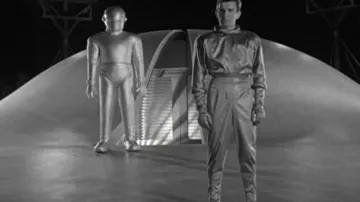
The universe grows smaller every day, and the threat of aggression by any group, anywhere, can no longer be tolerated. There must be security for all, or no one is secure.
Science fiction films are big business now, but they used to be smaller, high-concept films. They didn’t always work. There are a good number of retro flying saucer sci-fi films from the 50s that we’ve mostly forgotten about (except for those “preserved” by Mystery Science Theater 3000). The ones we remember, the ones that stand out in history, are usually the ones that have made us think. The Day the Earth Stood Still is a thinking sci-fi film with something to say. Directed by Robert Wise (West Side Story, Star Trek: The Motion Picture) and starring Michael Rennie, Patricia Neal, and Hugh Marlowe, this is a classic of the genre that’s remembered today as one of the best science fiction films of all time. Now that’s not to say that everything in it is timeless. What was once considered a very tense thriller is now a rather dull affair, compared to modern films. The plot is predictable and the dialogue is clunky. But the primary strength of the film—the importance of its message—is just as true and relevant today as it was in 1951, and that makes this film important even in a modern context.
The film opens with a flying saucer-style UFO speeding toward Washington. Klaatu, an alien who is remarkably like a human man, steps out and says he comes in peace. He is promptly shot—the first of its statements on society—and taken to a hospital to recover. In the hospital, Klaatu says he has a message for Earth’s leaders, but will only deliver it to them directly. He gets shut down pretty hard by some government lackey, so he sneaks out to go discover mankind for himself. In his absence, fear guides the discussions of this mysterious alien, and the government goes out to capture him as a matter of national security. But Klaatu’s message—a warning to our advancing species—is something he feels must be heard, and there may be dire consequences if he is not allowed to speak.
I am fearful when I see people substituting fear for reason.
The message that fear of the outsider should not cloud our better judgment was hugely important in 1951, as McCarthyism was starting to run rampant and the nuclear arms race was one of our government’s biggest priorities. In one sense, some of that is lost on modern viewers, but in another sense, we have our own modern xenophobic fears that have made this relevant once again. Other clever bits of social commentary are thrown in, such as when two doctors are questioning how the alien can live so long right before lighting up two cigarettes, but the heart of this film lies in fear of the outsider and a desire to use military power to prevent others from holding military power. What’s interesting was that, at the time, America’s growing nuclear arsenal was meant to be a deterrent to other world superpowers developing and using nuclear weapons—a message suspiciously similar to what Klaatu delivers to America. Is this about a bigger power stepping in to give America a taste of its own medicine? Or is it simply a more advanced species telling us to quit before things get ugly? The film’s not really clear on that, but the outcome is the same: our own xenophobia and rush for power are shown to be harmful and ridiculous.
In 2008, 20th Century Fox attempted to remake this film with Keanu Reeves as the mysterious alien Klaatu. The film bombed, garnering a measly 21% of movie review aggregator site Rotten Tomatoes. Now, I know what you’re thinking, but it’s not because of Keanu Reeves. The film was blasted for being heavy on special effects, but light on story—the exact opposite of the original film. In the modern incarnation, Klaatu’s warning is about humans destroying their planet. This has the potential to be somewhat relevant to a modern audience, but the metaphor of the visiting alien was completely lost. This is made even worse when you consider that the original message of the film was sorely needed at that time, as Americans feared foreigners once again and sought to gain military superiority for protection. So what could have been an edgy statement on the current political climate turned into a cheap but ultimately safe science fiction film that completely missed the point of the original.
But back to the original. This was originally considered a very tense movie, but that aspect of the film hasn’t aged well. Today, the film feels like it’s heavy on talk, but light on action. (Seriously, the climax of the film is a speech delivered by Klaatu.) Given the film’s intent of delivering a message, this isn’t necessarily a bad thing. In fact, most of the science fiction films of the 50s feel this way—it’s just where the genre was back then. Now, as a classic film, that’s become part of its charm. There’s something kind of endearing about how directly the film makes its point. That doesn’t make it any less interesting, however.
Should I Watch The Day the Earth Stood Still?
The Day the Earth Stood Still stands as one of the great sci-fi classics, but I won’t say it’s one for all modern audiences. With the maturation of film that’s happened since then, the message of the film, while still important, can seem simple or even quaint. The speed of the film lags far behind modern ones. But if you prefer your sci-fi to have more thinking than action, or just want to see one of the early classics that paved the way for later masterpieces, this is a great film to watch. I certainly enjoyed rediscovering this old classic.
Movies Like The Day the Earth Stood Still
- Forbidden Planet (1956) - This is a more stylized 50s sci-fi film that clearly inspired the early Star Trek series, but its core is the same: it’s a philosophical story that delivers a warning to mankind about our technological progression. In this case, the message is that technological advancement does not bring enlightenment; our technology will always be as evil or good as we are. If you liked The Day the Earth Stood Still, you should absolutely watch Forbidden Planet.
- It Came from Outer Space (1953) - This is a classic sci-fi film that embodies everything we love about classic sci-fi films: creepy aliens, xenophobic humans, and, most of all, a solid (if simple) message. In this film, the aliens aren’t invaders; they’re misunderstood explorers who mean no harm. But, shortly after their landing, they’re revealed to look very different from humans, and it’s our reaction to the different-looking aliens that drives the film’s conflict. In post-war America, this was something everyone needed to learn.
- The War of the Worlds (1953) - In this one, aliens arrive and show us the darkness inherent in humanity. At first, the aliens are terrible invaders, attacking human cities and killing humans. We learn they are attempting to punish us for our misdoings. As the aliens consume our civilization (and our humanity), the darkness inherent in humanity is too much for them, and they suffer their own fate. This was originally a radio play disguised as an actual broadcast, and it was so startling that listeners believed there was an actual alien invasion going on. A great classic sci-fi film that endures today.
- Runtime: 1:32
- Director: Robert Wise
- Year: 1951
- Genres: sci-fi
- Rating: NR

About Brandon
My name is Brandon, and I love movies. Not bad ones, though—just the good ones. I’m curating and reviewing a list of classic, essential-viewing, or just plain good movies from all decades, and I've been reviewing them since 2016. I also co-host Peculiar Picture Show, a podcast about movies and mental health and write about Dungeons & Dragons options, builds, and optimization.
More in Robert Wise
West Side Story: The Darkest Version of Romeo and Juliet Yet
1961
musical, romance
More in 1950s
The African Queen: A River Cruise Turns Into War Heroism
1951
adventure, romance
North by Northwest: The Iconic Classic Action Film
1959
action, mystery, thriller

Roman Holiday: The Classiest Romantic Comedy of All Time
1953
comedy, romance
More in sci-fi
The Girl Who Leapt Through Time: A Story of Fate and Love
2006
animated, drama, romance, sci-fi, teen
Close Encounters of the Third Kind: Science-Fiction With Heart and Soul
1977
drama, sci-fi
Jurassic Park: The Best Dinosaur Movie of All Time
1993
sci-fi, thriller